

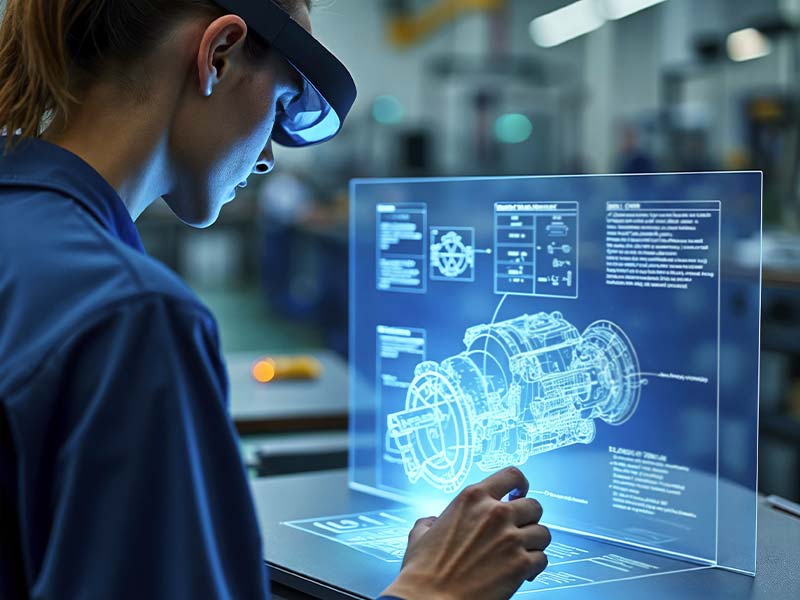
How Artificial Intelligence Is Changing the Future of Precision Machining
In recent decades, precision machining has evolved significantly thanks to automation, digitalization, and CNC technology. However, the most significant revolution is happening now: the integration of artificial intelligence (AI) in manufacturing processes. This technology is not only redefining how high-precision components are produced, but it is completely transforming the industry landscape, offering unprecedented opportunities for efficiency, quality, and innovation.
AI and Precision Machining: A Natural Combination
Precision machining requires extreme attention to detail, tight tolerances, and full control over every step of the process. This makes it an ideal environment for applying artificial intelligence, especially in tasks such as quality control, predictive maintenance, automated design, and machine programming.
Real-World AI Applications in Machining Shops
- Predictive Maintenance: Sensors installed on CNC machines continuously collect data such as vibrations, temperature, cutting speed, pressure, etc. AI analyzes this data in real time to predict failures before they happen. This reduces downtime and avoids costly unplanned stoppages, improving overall productivity. Cutting Parameter Optimization: AI can analyze thousands of combinations of tools, materials, and working conditions to recommend optimal cutting parameters. This results in longer tool life, shorter machining cycles, and less material waste. Generative Design: Using AI algorithms, it is possible to create designs that would be impossible to develop with traditional methods. AI takes into account functional requirements, geometric constraints, and available materials to generate the most efficient shapes, particularly useful in sectors like medical or aerospace. Automated Quality Control: AI-powered vision systems can inspect parts in-line, identifying defects that are imperceptible to the human eye at high speeds. This allows for continuous process improvement and ensures defect-free final products. CNC Programming Assistance: With machine learning, CNC programming software can now suggest more efficient toolpaths, reduce collisions, and optimize the sequence of operations. It can even “learn” from previous productions to program new projects with greater accuracy and less manual intervention.
- Optimización de Parámetros de Corte La IA puede analizar miles de combinaciones de herramientas, materiales y condiciones de trabajo para recomendar parámetros óptimos de corte. Esto significa mayor durabilidad de herramientas, ciclos de mecanizado más cortos y menos desperdicio de material.
- Diseño Generativo Utilizando algoritmos de IA, es posible crear diseños que serían imposibles de desarrollar con métodos tradicionales. La IA toma como insumo los requerimientos funcionales, las restricciones geométricas y los materiales disponibles para generar las formas más eficientes, especialmente útiles en sectores como el médico o aeroespacial.
- Control de Calidad Automatizado Sistemas de visión artificial impulsados por IA pueden inspeccionar piezas en línea, identificando defectos imperceptibles para el ojo humano con gran rapidez. Esto permite una mejora continua de los procesos y asegura productos finales sin fallas.
- Asistencia en Programación CNC Con el aprendizaje automático, los softwares de programación CNC ahora pueden sugerir trayectorias de herramientas más eficientes, reducir colisiones y optimizar la secuencia de operaciones. Incluso pueden “aprender” de producciones anteriores para programar nuevos proyectos con mayor precisión y menor intervención manual.
Key Advantages for the Industry
- Higher Precision and Repeatability: AI minimizes human variability, ensuring that each part is manufactured to the same quality standards.
- Operational EfficiencyCycle times are reduced, tool life is extended, and operational costs are minimized.
- Error Reduction:By continuously monitoring data and anticipating failures, AI reduces waste and rework.
- Accelerated Innovation:Companies can experiment with new shapes, materials, and processes without risking current production.
Use Cases Across Various Sectors
- Medical IndustryThe production of custom implants with minimal tolerances benefits from generative design and AI-powered quality control.
- Aerospace:Weight reduction in structural components through intelligent designs generated by AI.
Challenges and Considerations
Despite its advantages, the implementation of AI in precision machining also involves certain challenges:
- Investment Costs:Adopting technology requires significant initial investment.
- Workforce Training:It is crucial to train operators and programmers to work with intelligent systems.
- Integration with Existing Systems:AI must be integrated into established production environments.
Towards a Smart and Precise Future
At Integrated Precision Machining, we firmly believe that artificial intelligence is not a threat, but a powerful tool to elevate the quality, efficiency, and innovation of our processes. We are committed to the digital transformation of the industry and providing solutions that integrate technology, experience, and precision into every project.
AI is already making a difference, and its impact will continue to grow. Companies that strategically adopt these tools will not only survive in a competitive market: they will lead the industry of the future.
📱 Contact Us, to know out technology solutions.
📞 +506 4052-0760
📧 info@mecinpre.com
 English
  Spanish